Amine wash: Acid gas & CO₂ removal
Energy-efficient removal of acid gases and CO₂ from flue gas, and syngas using advanced, highly stable amine-based solvents

Air Liquide’s Amine Wash technology uses advanced specialty amines to efficiently remove acid gases and CO₂ from industrial streams, enabling large-scale carbon capture and low-carbon hydrogen production.
Syngas purification and blue hydrogen
When treating syngas, our Amine Wash process (using specialty solvents such as BASF OASE® white) is highly versatile, operating irrespective of pressure levels or initial CO₂ content.
- Extreme Purity: It can achieve CO₂ specifications in the treated gas of < 20 ppm, making it ideal upstream of coldboxes or ammonia processes.
- Energy Transition Ready: It achieves CO₂ capture rates from syngas of more than 99% to produce low-carbon Hydrogen.
- High-Grade CO₂: Because the process has very low co-absorption, it delivers a CO₂ product purity of > 99%.
Flue gas CO₂ capture
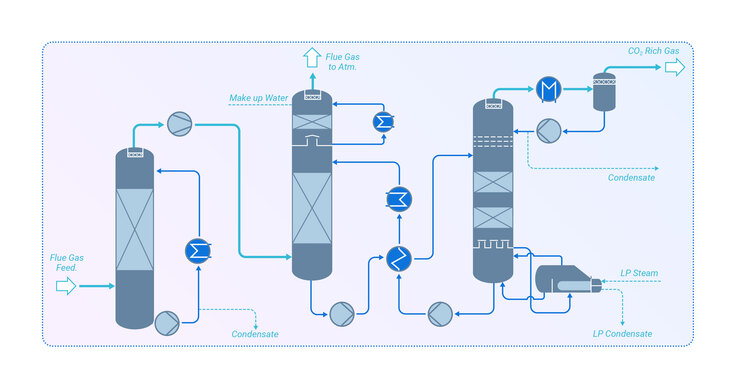
For oxygen-containing feedstocks like industrial flue gases with 3% to 25% CO₂, we employ highly stable, second-generation amine solvents such as BASF OASE® blue
This energy-efficient solution reaches CO₂ capture rates of up to 98%, delivering a CO₂ product specification of > 99.9% purity at capture capacities up to 4,000 tonnes per day per train.
Breaking the steam barrier: Decoupling amine carbon capture from site utilities
Integrating amine-based carbon capture is traditionally challenged by a reliance on low-pressure steam, a utility many industrial sites simply do not have. Air Liquide offers innovative engineering pathways to decouple carbon capture from conventional steam infrastructure, enabling deep decarbonization across diverse and challenging industrial landscapes. We provide a comparative analysis of technologies best suited for specific industries such as cement, pulp and paper, waste to power and steam methane reforming based on their unique energy profiles.
- Alternative steam production: implementation of electric boilers / gas (natural gas, offgases,...) or alternatively (i.e. wood) fired auxiliary boilers with or without additional carbon capture
- Thermal oil can be more efficient than steam production and additionally offers the option for heat integration with upstream units
- Heat Pumps offer the opportunity to use low grade heat to produce steam or provide a direct heating medium for amine reboiling.
Complex feed gases & taylor made amine washes
Air Liquide addresses the reality of complex flue gas compositions and feed fluctuations over standardized solutions. By prioritizing integration expertise over rigid boundary conditions, Air Liquide shows how to transform site-specific constraints into optimized assets. Our clients profit from a roadmap for implementing robust amine wash systems in low-to-medium CO₂ environments.
- Experienced partnership: With over 35 years of partnership with BASF and over 30 OASE-based amine units designed and built worldwide, Air Liquide is able to build on BASF’s vast know-how of amine chemistry, trace component handling and emission control for OASE-based projects.
- On-spec product and flue gas to atmosphere: our Amine Washes are built to deal with fluctuating feed gas flows and compositions, ensuring an on-spec CO2 Product and a treated gas with low emissions at all times
- Integration with other Air Liquide technologies, such as eMeOH or CO2 liquefaction offer the opportunity to optimize the overall plant setup as well as enable us to propose overall product guarantees.
Frequently Asked Questions (FAQ)
How does the Amine Wash process work?
Acid gases contained in raw gases are removed by absorption with an amine-based solvent. The rich solvent leaving the contactor is then regenerated by flashing and stripping.
Can Amine Wash be used for low-carbon Hydrogen production?
Yes. The Amine Wash process can achieve CO₂ capture rates from syngas of more than 99%, which enables the production of low-carbon Hydrogen.
Can Amine Washes be operated without having steam available on site?
Yes. There are multiple options to externally generate steam or heat a medium for reboiling, for example auxiliary boilers, heat pumps or thermal oil loops.
Our carbon capture solutions
-
Cryocap™FG and Cryocap™ SteelDiscover Air Liquide's Cryocap™ FG and Steel technologies. Capture CO₂ from flue gases and steelmaking streams using efficient cryogenic separation.Read more
-
Cryocap™H2Maximize efficiency with Air Liquide's Cryocap™ H₂ technology. Capture up to 98% of CO₂ from syngas while boosting hydrogen production by 10-20%.Read more
-
Cryocap™ OxyDiscover Air Liquide's Cryocap™ Oxy for oxycombustion plants. Capture up to 98% of CO₂ from power and cement kiln flue gases with smart purification.Read more
-
Cryocap™ LQDiscover Air Liquide's Cryocap™ LQ technology. Flexible, low-OPEX large-scale CO₂ liquefaction from 700 to over 7,000 tonnes per day.Read more
-
Pressure Swing Adsorption (PSA)Air Liquide's PSA technology delivers ultra-pure hydrogen (up to 99.9999%) and efficiently concentrates CO₂-rich tail-gases for advanced carbon capture.Read more
-
Recticap™Produce low-carbon hydrogen with Recticap™, Air Liquide's tailored technology for highly efficient CO₂ removal from natural gas reforming.Read more


Our Carbon Capture Solutions
See our technologiesContact us
Send a message